BS EN 15266:2007 is the European standard for stainless steel pliable corrugated tubing kits for gas at operating pressures up to 0.5 bar. It defines what a CSST kit has to be: the tube material, the fitting and seal system, the mechanical strength, the fire performance, and the marking. It does not certify any individual product. That part is the BSI Kitemark. Flexigas holds Kitemark KM 598726 to BS EN 15266:2007, which means BSI third-party tested it to the standard and audits the factory. The standard covers 1st, 2nd and 3rd family gases per EN 437 at MOP 0.5 bar. On the bench it means Flexigas passes reaction to fire B-s1-d0, stays tight in fire at 650C for 30 minutes, and passes EN 1775 Tests A and B. On site you install to BS 6891:2015 for DN15 to DN32 and IGEM/UP/2 for DN40 and DN50, as a Gas Safe registered engineer under the Gas Safety (Installation and Use) Regulations 1998. The standard plus the Kitemark is what satisfies building control.
If you have fitted CSST you have probably seen "BS EN 15266" stamped on the box and wondered what sits behind it. This is a plain reference for Gas Safe registered engineers: what the standard says, how Flexigas meets it, and why the standard plus the Kitemark is the bit building control cares about.
1. What BS EN 15266:2007 actually is
BS EN 15266:2007 is the harmonised European standard for "stainless steel pliable corrugated tubing kits in buildings for gas with an operating pressure up to 0.5 bar". In plain terms, it defines what a CSST system has to be before it can be sold and installed for gas in the UK and across Europe.
Two words matter in that title. Kit, because the standard does not test a length of tube on its own. It tests the tube, the fittings and the seal as a system. And 0.5 bar, because that ceiling is built into the standard. Anything above it is out of scope.
The standard is what your product is measured against. The Kitemark (Section 4) is the proof a specific product was measured and passed. Keep those two ideas separate and the rest of this falls into place.
2. What the standard specifies
BS EN 15266:2007 sets requirements across four areas. This is the short version of each.
Materials
The standard specifies the metallurgy of the corrugated tube. For Flexigas that means 316L stainless steel (the standard covers 316L and 321 grades; current Flexigas production is standardised on 316L), with CW602N dezincification-resistant brass fittings. Specifying the materials means the kit resists corrosion over a long service life rather than being left to the manufacturer to choose.
The fitting and seal system
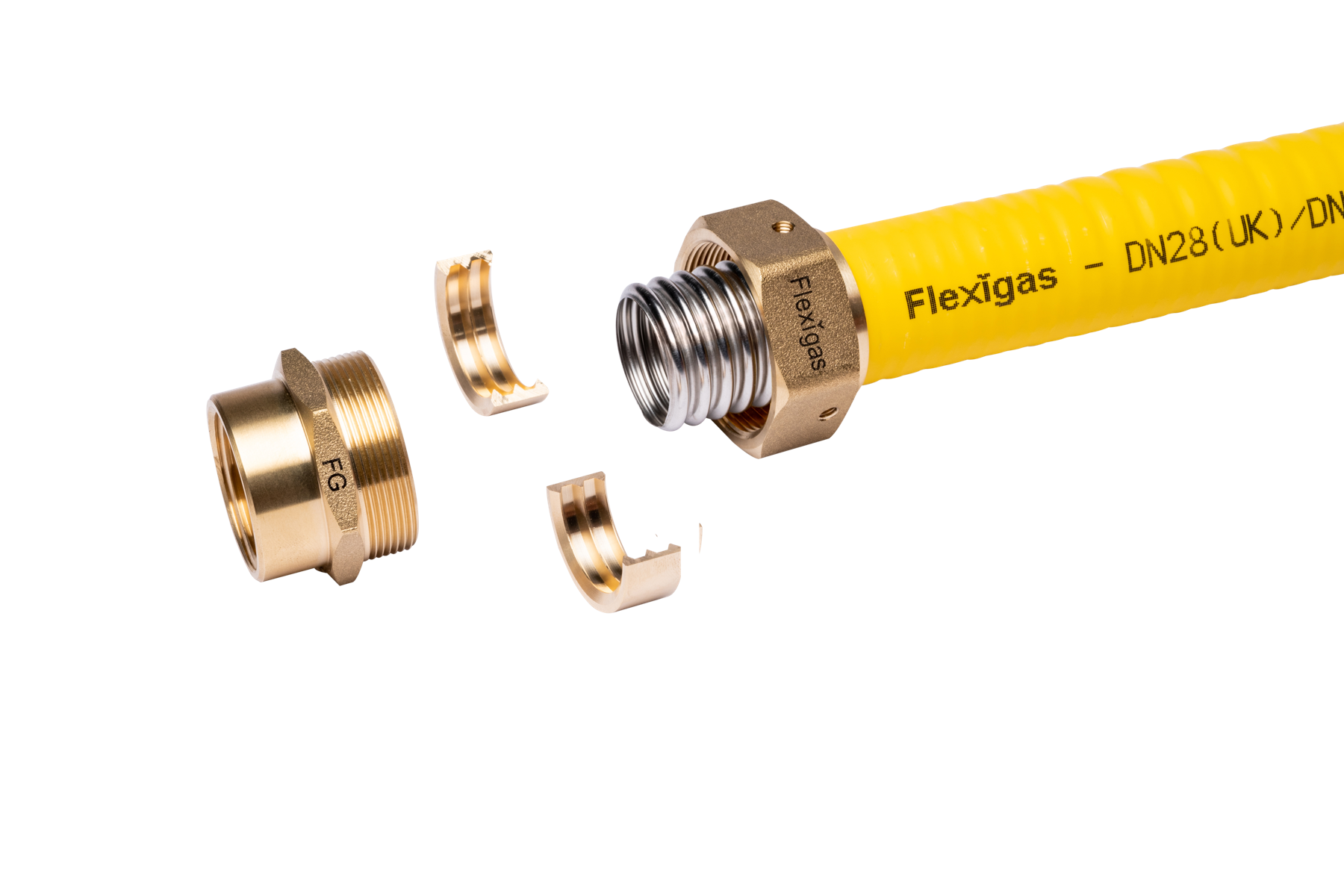
The standard defines how the tube and fitting join and how the gas-tight seal is made. Flexigas uses a mechanical metal-to-metal seal: the corrugated stainless steel self-flares against a brass seat as the two halves of the fitting are tightened. No solder, no flux, no jointing paste, no PTFE on the seal. The standard sets the performance the joint must deliver, tested as part of the kit, which is exactly why mixing CSST brands is not permitted (Section 6).
Mechanical and fire performance
The kit has to survive real-world handling and abuse: tensile loads, bending and re-bending, pressure cycling, and gas tightness held under load. It also has to meet defined fire performance, covered in Section 5.
Marking
The standard sets what must be marked on the tube and packaging so an installer or inspector can identify the product, the size and the standard it was made to. That is why you see the metre-marked tube and the standard reference on every Flexigas box and spool.
3. MOP 0.5 bar and the gas families
The maximum operating pressure for any product to BS EN 15266:2007 is 0.5 bar. Flexigas is rated to that ceiling, and no higher. Do not quote a higher figure.
That 0.5 bar envelope covers the 1st, 2nd and 3rd family gases defined in EN 437:
- 1st family gases (town gas / manufactured gas).
- 2nd family gases (natural gas, the everyday domestic supply).
- 3rd family gases (LPG, propane and butane).
So a single Kitemarked product handles the gas you meet on a domestic natural gas job and the LPG you meet on a rural or commercial install, within the same 0.5 bar limit. The pressures you actually work at sit well below the ceiling (a natural gas domestic meter regulates at 21mbar).
4. How Flexigas meets it: the BSI Kitemark
This is the part installers and building control rely on. The standard sets the bar; the Kitemark is the independent proof a product cleared it.
Flexigas holds BSI Kitemark KM 598726, certified to the BS EN 15266:2007 scheme. The Kitemark is not a self-declaration. To carry it, BSI third-party tests the product to the standard and then audits the manufacturing on an ongoing basis, so the product you buy today is made the same way as the one that was tested. The current certificate runs to 11 July 2027.
The Kitemark scheme for Flexigas also carries two specific scheme references worth knowing if you use the adapter range:
- PP1634, covering the special adapter fittings.
- PP1691, covering the integrated earth terminals (FG Bond).
Those scheme references come with hard conditions. The FG Link / A-XX adapter fittings may only be used by installers who have completed the Flexigas training, and only with fittings on the Flowflex Compatible Model List. Step outside those conditions and you void the certification. The headline rule for everyone else: Flexigas tubing only ever connects to Flexigas fittings (Section 6).
5. Fire performance under the standard
Fire behaviour is one of the reasons CSST is held to a formal standard. Flexigas meets the fire requirements three ways, all third-party verified under the Kitemark:
- Reaction to fire: B-s1-d0. This is the Euroclass for the product's contribution to a fire. B-s1-d0 means very limited contribution to fire (B), the lowest smoke production class (s1), and no flaming droplets or particles (d0).
- Tightness in fire: 650C for 30 minutes. The kit stays gas tight when held at 650C for 30 minutes (at a leakage rate below 150 dm³/h). That is the property that matters when pipework passes through a fire compartment.
- EN 1775 Tests A and B passed. EN 1775 is the standard for gas pipework in buildings up to 5 bar. Flexigas passes both Test A and Test B under it.
On a real install these properties are why CSST can be routed through ducts and compartment floors with the fire-stopping arrangements set out in BS 6891, and why a Kitemarked product behaves as the design assumes.
6. Why mixing CSST brands voids it
The standard tests a kit: one manufacturer's tube with that same manufacturer's fittings and seal. The seal, fire and mechanical performance were all certified on that combination and only that combination.
Connect Flexigas tubing to another manufacturer's CSST fittings, or the reverse, and you are installing something nobody tested and nobody certified. It is outside the scope of KM 598726 entirely. The Installation Manual is unambiguous: "Flexigas tubing is only compatible with Flexigas fittings. No Flexigas components should ever be connected directly with any other CSST systems despite how similar they may appear."
Doing it anyway voids the BSI Kitemark and the warranty. Connecting Flexigas to a different type of pipework (copper, iron, brass) is fine through approved BSP thread connectors, never tube-to-tube with another CSST brand.
7. What the standard means on a real install
BS EN 15266:2007 sets what the product is. It does not replace the UK installation standards that govern how you fit it. On a real job you work to:
- BS 6891:2015 for DN15 to DN32 (low-pressure gas tubing in domestic premises).
- IGEM/UP/2 for DN40 and DN50 (above the scope of BS 6891).
- BS 7671 for equipotential earth bonding of the gas installation pipework. The integrated FG Bond terminal is BSI-tested to BS 951:2009 to make that bond.
- IGE/UP/1B for gas tightness testing, and IGEM/UP/1A or 1B for purging.
And the non-negotiable: all gas work in the UK (including Northern Ireland and the Isle of Man) must be carried out by a person registered with Gas Safe, holding a valid ACS or allied NVQ/SVQ, in accordance with the Gas Safety (Installation and Use) Regulations 1998. Where the Regulations or a British Standard conflict with the manufacturer's manual, the Regulations and the Standard take precedence.
For sizing, it is the same equivalent-length, pressure-loss method you already use, with figures specific to Flexigas. Use the Flexigas in-browser sizing calculator at flexigas.com/gas-pipe-sizing-calculator/ for anything beyond a simple run, or the tables in Section 29 of the Installation Manual.
8. Why the standard plus the Kitemark satisfies building control
Building control needs evidence that the pipework is a product fit for purpose, fitted by a competent person. Two things provide it:
- BS EN 15266:2007, the recognised standard the product is built to.
- BSI Kitemark KM 598726, the independent third-party proof this specific product meets the standard, backed by ongoing factory audit.
A standard reference on its own is a claim. The Kitemark is verification of that claim by an accredited certification body. With your Gas Safe registration and an install carried out to BS 6891 / IGEM/UP/2 and tested to IGE/UP/1B, that is the compliance trail building control is looking for. The difference between "made to a standard" and "independently certified to a standard" is, on gas work, the whole point.