
If you install copper, you already know about 80% of installing Flexigas. The bend radii, support spacings, joist rules, wall protection, bonding requirements, gas tightness testing and sizing principles all follow BS 6891 the same way copper does. The 20% that differs is the termination. Flexigas seals mechanically (the corrugated tube self-flares against a brass seat as you tighten two spanners), so there is no soldering, no flux, no jointing compound and no PTFE on the seal. Cuts go in the valley between corrugations. Wrap silicone tape only after the gas tightness test passes. Earth bond every install per BS 6891 (the integrated FG Bond terminal makes this faster). And Flexigas tubing only ever connects to Flexigas fittings. Mixing CSST brands voids the BSI Kitemark KM 598726 and your warranty.
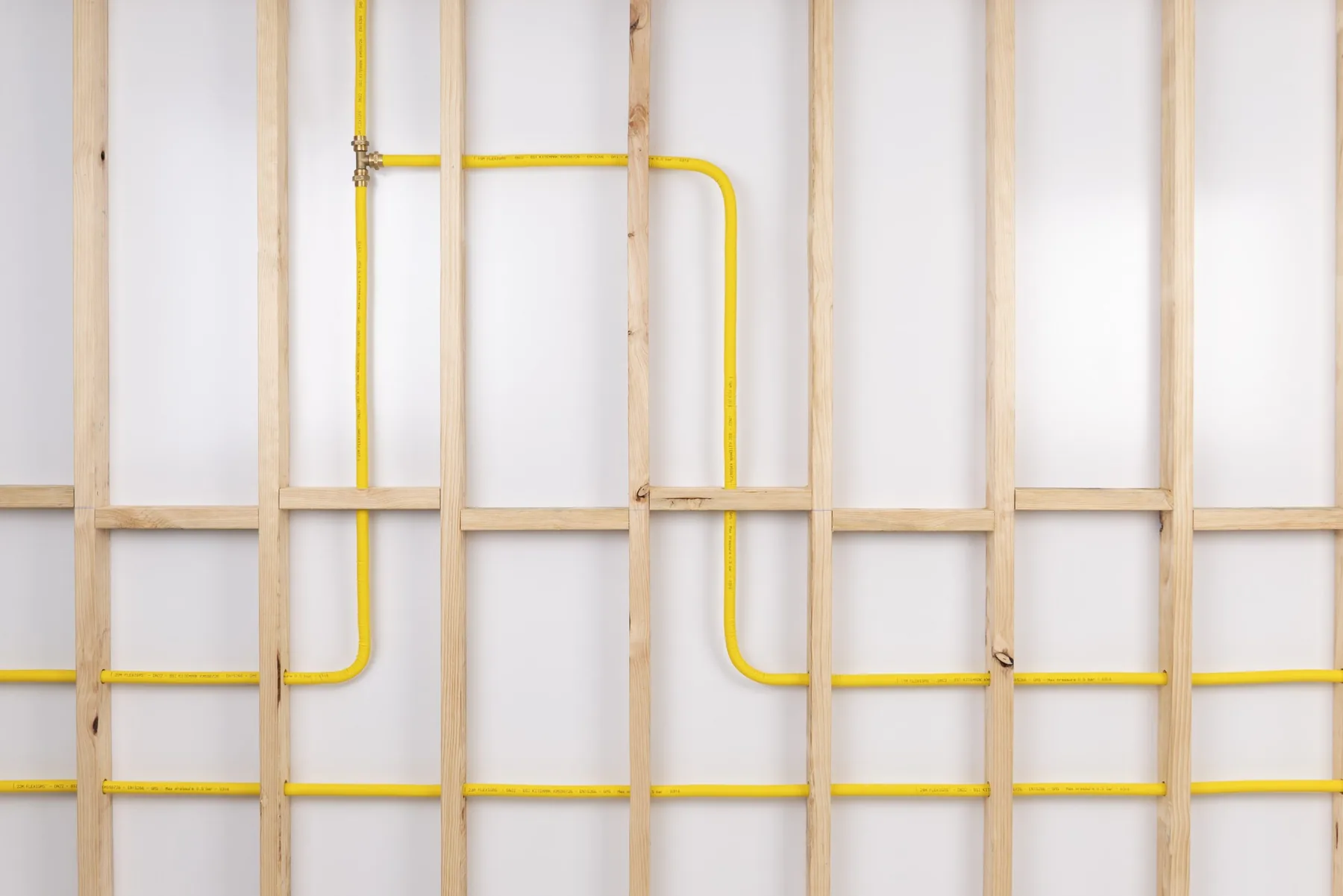
A practical install reference for Gas Safe registered engineers fitting Flexigas Corrugated Stainless Steel Tubing on domestic and light-commercial gas work. No marketing copy. Just what you need to get an install right first time.
1. If you install copper, you already know most of this
The Installation Manual is built on BS 6891:2015 (for DN15 to DN32) and IGEM/UP/2 (for DN40 and DN50). Those are the same standards your copper installs already follow. So what carries over, and what is genuinely new?
What carries over from copper
- DN sizes: 15, 22, 28, 32, 40 and 50, same notional bore.
- Support spacing: 1.2m for DN15, 1.8m for DN22 and DN28, 2.5m for DN32 to DN50, vertical and horizontal alike.
- Joist rules: pipework runs in the direction of joists or at 90 degrees, never diagonal. Joists under 100mm or over 250mm cannot be notched. Same logic as copper.
- Wall protection: within 50mm of a plasterboard face, protect with 1mm steel plate (or a sleeve where appropriate). Same as copper.
- Cavity walls: never within the cavity itself. Same rule, same reason.
- Burial cover: 375mm in gardens, 475mm under light traffic, 600mm under heavy traffic. Same minima as for any buried gas pipework.
- Earth bonding: required per BS 6891 and BS 7671. Same regulation, same purpose.
- Gas tightness testing: per IGE/UP/1B before commissioning. Purge per IGEM/UP/1A or 1B. Same procedure as any low-pressure domestic install.
- Emergency control valves: ECV at the inlet of the primary meter. AECV where the meter is 6m or more from the building, or inside individual flats served by remote or communal meters. Same compliance.
- Pipe sizing: same pressure-loss budget (1mbar between meter outlet and appliance for natural gas domestic), same equivalent-length method, same appliance gas rates.
What is genuinely new
- No hot works at the joint. The seal is mechanical. The corrugated tube flares against the brass seat as the two halves of the fitting compress it. No solder, no flux, no jointing compound, no PTFE.
- Cuts go in the valley between corrugations, not anywhere along the run. Wheel pipe cutter only. A hacksaw will not give you the clean square edge the seal needs.
- Fewer joints per run. Flexigas comes in 15m, 25m, 50m, 75m, 90m, 200m, 350m and 400m coils. You can pull a continuous run from meter to appliance through the joists with no joints in between (assuming the route allows).
- The pipe bends instead of using elbows. Tight bends still count as an elbow fitting for pressure-loss purposes, but a sweeping bend made by the tube itself adds only the equivalent length of a 90 degree bend (0.3m) rather than a proper elbow (0.9m). On big runs that adds up.
- Bend radii are bigger than copper. Minimum 20mm at DN15 (suggested 75mm), increasing to 90mm minimum at DN50 (suggested 125mm). Repeated bending of the same section during install should be avoided.
- Direct burial without sleeving, where the cover is checked and undamaged. The yellow polyethylene cover is tested to EN 15266 and BS 7838 for direct burial. Copper needs separate protection.
- In solid floor screed without sleeving (Standard Flexigas), provided minimum 25mm cover above the tube. Fittings still cannot be buried.
- Silicone tape wrap after the tightness test, never before. If you tape before testing, you cannot see a leak at the joint.
- Flexigas DS transition. Where a route involves unventilated voids, unventilated risers, solid walls or solid floors, confirm the current DS guidance with Flexigas technical support before specifying. DS has historically been used for pipe-in-pipe and sleeving applications, but the range is currently in transition.
- Flexigas fittings only. Direct joining to other CSST systems is strictly forbidden. Joining to other piping systems (copper, iron, brass) happens through approved BSP thread connectors only.
That is the short answer. The rest of this guide is the detail.
2. What you need
Tools
- Wheel metal pipe cutter (TCR-01 sold by Flexigas, or any equivalent wheel cutter). Small cutter handles DN15 to DN22, large cutter handles DN28 to DN50.
- Utility knife for removing the yellow flame-retardant polyethylene cover.
- Two open-end spanners for tightening the fitting. No torque-specific tools, no press tool.
- Silicone tape (FG-TAPE, ST-01 for 2m or ST-02 for 11m, free in every box and spool).
- Earth bonding cable, minimum 10mm² cross section, green and yellow insulation, construction reference 6491X to BS 6004.
Materials
- Flexigas CSST (Standard or DS) sized per Section 5 below.
- Flexigas fittings only. Genuine Flexigas tubing with genuine Flexigas fittings. Section 24 of the Installation Manual is unambiguous: "Flexigas tubing is only compatible with Flexigas fittings. No Flexigas components should ever be connected directly with any other CSST systems despite how similar they may appear."
- Sleeving where required (copper, steel, polyethylene or PVC, per Section 14 of the Manual).
- 1mm steel plate where required (within 50mm of plasterboard or where penetration risk exists).
Certification (mandatory)
In the UK (including Northern Ireland and the Isle of Man) all work on gas installations must be carried out by a business or self-employed person registered with Gas Safe. The engineer must hold a valid ACS (Nationally Accredited Certification Scheme) or NVQ/SVQ certificate. All work must comply with the Gas Safety (Installation and Use) Regulations 1998, British Standards, local Building Regulations and this Manual. Where Regulations or British Standards conflict with the Installation Manual, the former takes precedence.
3. Before you start
The standards that apply
The Installation Manual lists these as the most relevant standards for a Flexigas installer:
- BS 6891:2015 (low-pressure gas tubing up to 35mm in domestic premises)
- BS/EN 15266:2007 (stainless steel pliable corrugated tubing kits for gas, up to 0.5 bar)
- IGEM/UP/2 (industrial and commercial pipework, used for DN40 and DN50)
- BS 7671:2008 (electrical installations, used for bonding)
- BS 951:2009 (earthing clamps specification)
- BS/EN 1775:2007 (gas tubing for buildings, maximum operating pressure up to 5 bar)
- IGEM/UP/1 or 1B (tightness testing and purging)
- IGEM/UP/5 (gas in multi-occupancy buildings)
- IGEM/UP/7 (gas in timber-framed and light-steel-framed buildings)
Pressure rating
Maximum operating pressure for Flexigas is 0.5 bar, per BS/EN 15266 and BS 6891.
Sizing the system
Three options:
- The Flexigas in-browser sizing calculator (at flexigas.com/gas-pipe-sizing-calculator/)
- Tables 1 to 6 in Section 29 of the Installation Manual (also in Section 17 of this guide)
- Manual calculation per Section 28 of the Installation Manual
Two things that catch people out:
- Pressure loss in Flexigas is slightly different to copper. You cannot just swap copper for Flexigas at the same diameter and assume the install works. Calculate.
- Add equivalent lengths for each fitting. A 90 degree bend by the tube itself is +0.3m. A tee through-flow is +0.3m. A tee diverted-flow is +0.9m. A coupling or union is +0.3m. An elbow fitting (rather than a bend made by the tube) is +0.9m at DN15 to DN28, and +1.0m at DN32 to DN50.
The Installation Manual recommends a maximum pressure loss of 1mbar between meter outlet and appliance for domestic natural gas, with meter pressure at 21mbar (BS 6891). Low-pressure third-family gas supplies regulate at 28mbar (butane) and 37mbar (propane) with pressure drop not exceeding 2.5mbar (BS 5482).
Standard Flexigas and DS transition guidance
Pick the compliant route by where the pipe goes. Where DS may be relevant, confirm current availability and guidance with Flexigas technical support before specifying.
| Where the pipe goes | Standard Flexigas | DS transition guidance |
|---|---|---|
| Ventilated voids | Yes (no sleeve) | Contact Flexigas before specifying DS |
| Unventilated voids | Sleeve required (Section 14) | Contact Flexigas before specifying DS |
| Unventilated risers | Sleeve required | Contact Flexigas before specifying DS |
| Through solid walls | Sleeve required | Contact Flexigas before specifying DS |
| Through solid floors | Sleeve required | Contact Flexigas before specifying DS |
| In floor screed (covered) | Yes (no sleeve, 25mm min cover) | Contact Flexigas before specifying DS |
| Direct buried in ground | Yes (cover checked, silicone-taped) | Contact Flexigas before specifying DS |
| Through structural elements | Not permitted | Not permitted |
If your route is straightforward and ventilated, Standard Flexigas may be suitable. If the route crosses anywhere unventilated or enclosed, or you are considering DS for a new project, speak to Flexigas technical support before final specification.
4. The seven-step termination
This is the core of every Flexigas connection. The same seven steps for every fitting, every size, Standard or DS.
Step 1, Cut
Use the wheel metal pipe cutter. Centre the cutting wheel in the valley between corrugations, not on a crown. Rotate the cutter steadily, tightening only slightly on each full revolution. The cut needs to be clean, square and circular with no sharp edges. A rough or angled cut will not seat properly against the brass seat.
Step 2, Remove
Use the utility knife to strip back the yellow flame-retardant polyethylene cover. Expose the last four corrugations of the stainless steel, no more, no less. Too little and the fitting cannot seat fully. Too much and you have created exposed stainless steel that needs taping later.
Step 3, Slide
Slide the fitting nut over the tubing first. Then place the two semi-circular collets (the grab rings) around the tubing so the ridges on the collets occupy the last three valleys of the exposed corrugations. The collets grip the tube and force it forward into the brass seat as you tighten.
Step 4, Tighten
Tighten the nut against the fitting body using two suitably sized spanners. One spanner holds the fitting body, the other turns the nut. Tighten progressively until resistance increases significantly. The seal forms when the last corrugation deforms around the seat inside the fitting. The Manual phrase is "use sufficient torque", which in practice means you feel the resistance rise sharply and then plateau.
The seal uses no jointing paste, no PTFE tape, no sealant of any kind. The corrugated stainless steel self-flares against the brass seat as the primary seal. Some fittings include a secondary O-ring that abuts the collapsed tube. Adding tape or paste to the seal breaks the mechanism, not improves it.
Step 5, Wrap
Only after the gas tightness test has passed, wrap the small gap between the fitting's tail and the tube using yellow silicone tape (FG-TAPE). Minimum 50% overlap to give double-layer cover. This protects the small exposed section of stainless steel from chloride attack in the surrounding environment.
If you tape before testing, you cannot see leaks at the joint during the test. Tape after.
Step 6, Attach
Attach the bonding nut to the fitting body using the pre-drilled holes. Attach the "SAFETY ELECTRICAL CONNECTION, DO NOT REMOVE" warning label between the earthing terminal and the Flexigas nut. The plastic label has a small hole that the earthing terminal passes through.
Step 7, Bond
Strip the earthing cable to reveal 1cm to 2cm of copper wire. Feed it into the FG Bond terminal. Screw down onto the copper wire with the cable running parallel to the tubing. Connect the other end to the main earthing terminal per Section 11 of this guide and Section 20 of the Installation Manual.
That is the entire termination process. Same seven steps every time.
5. Routing in joisted floors and roof spaces
Flexigas in joisted floors and roof spaces shall run in the direction of the joists or at 90 degrees to them. Diagonal runs are not permitted (same as copper).
Notches must comply with Figures 1A to 1D in the Installation Manual. Joists less than 100mm or greater than 250mm shall not be notched.
Solid timber joists
Notch positions and drill positions are limited by the BS 6891 figures. The key constraints:
- Top notching where drilling and notching occur: depth ≤0.125 of joist depth, position between 0.07L and 0.25L from each support, length ≤0.25L
- Alternative top notching: depth ≤0.15D, position between 0.1L and 0.2L
- Drilling: holes spaced no closer than 3× diameter of the largest hole, minimum 100mm between any hole and any notch, hole diameter ≤0.25D
- Bottom notching: depth ≤0.15D, position between 0.1L and 0.2L from each support
The Manual gives detailed figures. Reference Section 11 and Figure 1A in the Manual rather than guessing.
Metal-web joists
The pipework passes between the metal webs, with pipe supports fixed to the top or bottom of the timber flanges, not in contact with the metal structure. Do not damage the webs.
Timber-engineered joists
Pipework installs through the web of the joist per the joist manufacturer's guidance and Figure 1C. Do not notch, drill, or cut the timber flanges. Do not expose the timber to moisture.
Solid timber joists with flooring across
Pipework laid across solid timber joists fitted with flooring goes in purpose-made notches or circular holes per the figures. Be careful when re-fixing flooring not to drive a nail or screw into the pipe. Where possible, mark the flooring to warn other trades.
Roof spaces
Roof spaces using vapour-permeable underlay without specific ventilation (no soffit board vents, for example) are treated as unventilated voids for gas pipework. Where pipework must go in such spaces, additional ventilation is required (at least two ventilators per space, each at least 50cm² free area, at low level for LPG and LPG/Air mixtures, at high level for natural gas).
Pipework shall not be laid below or within roof space insulation material.
Joist spans and ventilation
Where pipework is installed in a void under a floor, or within intermediate joisted floors, unless there is sufficient adventitious ventilation available, ventilation shall be provided per Section 15 of the Manual. For LPG and LPG/Air mixtures this ventilation goes at the lowest point.
Drill holes for service runs
Recommended drill hole size is 20mm larger than the Flexigas DN size. So DN22 wants a 42mm hole, DN28 wants a 48mm hole, and so on.
Fire compartment floors
Pipework shall not be installed within any fire compartment floor that separates one dwelling from another part of the building. The exceptions are shown in Figures 1C and 1D of the Manual (concrete compartment floors with vented ducting, suspended timber compartment floors with similar arrangement).
6. Routing in solid floors
The Flexigas plastic cover complies with section 8.10.7 of BS 6891:2015. The cover meets the requirements for direct burial (factory-finished protection). Standard Flexigas does not require additional sleeving when placed in floor screed.
That said, BS 6891 section 8.10.6 and Regulation 208 19(2)(b) of the Gas Safety (Installations and Use) Regulations both require all gas pipework to be protected against damage caused by movement (subsidence, structural movement) as best as possible. If you judge the tubing may be subject to unforeseen movement from the solid floor, it is considered best practice to place the Flexigas in a suitable sleeve per Section 14 (as you might with rigid copper).
Cover, inspection and prep
- Inspect all buried pipework for damage before placing in a solid floor.
- Any gaps or holes in the plastic cover get wrapped with silicone tape, at least 50% overlap to provide double-layer cover.
- Test the installed Flexigas for gas tightness before covering with floor screed.
The numbers
- Minimum 25mm cover above the Flexigas tubing or sleeve when buried in concrete screed.
- Flexigas fittings shall not be directly buried in any solid floor. If a fitting is required within the floor screed, use a removable below-ground box (a "conduit junction box", available from your plumbing merchant) so the fitting can be accessed if needed.
- Flexigas shall never be buried in structural elements of the floor (concrete slabs, structural toppings). Not in power-floated floors that form part of the structure. Acoustic floors only with the agreement of the building designer.
Direction
Where Flexigas runs in solid floors, run parallel to or at 90 degrees to the walls.
Suspended concrete floors
Run within vented ducting that extends above floor level. See Figure 2B in the Manual.
7. Routing in walls
Pipe runs
Where possible, Flexigas in walls should be vertical, placed in ducts with convenient access points or in pipe chases. Secure the pipework and keep joints to a minimum.
Damage check before placement
Inspect for damage before placing within a wall. Repair any cover damage with silicone tape (50% overlap minimum, one pass to the next).
Cavity walls
Flexigas tubing shall not be placed within the cavity of a cavity wall. Every pipe passing through a cavity wall takes the shortest practicable route and is sleeved per Section 14 (see Section 8 of this guide).
Dry-lined walls
Flexigas behind dry lining shall be suitably encased by building material. Where the tube passes within 50mm of the decorative face of the plasterboard, protect it with 1mm steel plate.
Timber-frame and light-steel-frame walls
Flexigas within timber-frame or light-steel-frame walls shall:
- Be run within purpose-designed channels or ducts
- Be adequately secured
- Have as few joints as practicable
- Be protected from mechanical damage
- Not be positioned where the tube could be penetrated by a 50mm nail or screw. Either keep the tube at least 50mm from the face of the plasterboard, or place a 1mm steel plate between
Flexigas passing from one side of a timber-frame or light-steel-frame construction to the other shall take the shortest practical route and be sleeved.
Solid walls
Where Flexigas passes through a solid wall, sleeve per Section 14 (next section).
Sealing studs
Where pipework passes through stud walls, the joints between the studs should be sealed with mastic to prevent gas tracking around the studs in the event of a leak.
8. Sleeves
Sleeves shall be of a material capable of containing gas: copper, steel, polyethylene (PE), or polyvinyl chloride (PVC).
Where sleeves are required (with Standard Flexigas)
Pipework passing through a wall or a floor, whether or not it contains a cavity, shall pass through a sleeve, with the exceptions outlined in Sections 6 and 7 above for screed and properly protected dry-lining runs.
DS transition note
Flexigas DS has historically been used for pipe-in-pipe and sleeving applications. The DS range is currently in transition, so confirm current DS availability, document set and installation guidance with Flexigas technical support before specifying it for walls, floors, unventilated voids or unventilated risers.
Sleeve installation rules
- Sleeves pass through the full width of the wall or full thickness of the floor
- Sleeves shall not impair the fire resistance of the wall or floor
- The annular space between pipe and sleeve is sealed at one end with a flexible fire-resistant compound
- Where a sleeve passes through an exterior wall, the seal goes on the inside of the wall (to prevent water ingress)
- Flexigas fittings shall not be located within the sleeve
- The outside of the sleeve is secured and sealed at each end to the structure with a suitable building material (cement mortar)
- The internal diameter of the sleeve allows an annular space around the pipe for insertion and sealing
9. Exterior pipework and direct burial
The Flexigas cover has been tested to both EN 15266 and BS 7838 to specifically meet the requirements for direct burial. No additional sleeving required, subject to cover inspection.
External cover (buried)
| Location | Minimum cover |
|---|---|
| Soil, gardens, no vehicular traffic | 375mm |
| Below drives with light vehicular traffic | 475mm |
| Below drives with heavy vehicular traffic | 600mm |
For more on burial, refer to BS 6891:2015 section 8.13.
Before burial
- Inspect the cover for any holes or gaps
- Wrap any damage with self-adhesive silicone tape, at least 50% per pass to ensure a double layer, to prevent corrosion from surrounding soil
- Flexigas fittings shall not be installed below ground. Terminate above ground first.
Exposed external runs
Flexigas is UV stable. The cover is suitable for external exposure with no further protection or labelling required. Check the cover has no holes. Ensure the gap between the cover and the fittings is properly covered with self-adhesive tape.
For commercial or LPG external installations, consult the relevant standards.
Direct connection to the gas meter
Flexigas can be directly connected to the gas meter, providing the gas meter is securely attached to the floor or wall. If the meter is not adequately restrained, use rigid pipework (copper) for the first 600mm before transitioning to Flexigas.
The integrated FG Bond earthing terminal makes meter-side bonding easier. The earthing conductor attaches at the gas meter.
Pipework in fireplace openings
CSST including Flexigas is not suitable for use in the openings of all-fuel fireplaces. Soot and debris can be particularly corrosive. If Flexigas is being used in such a scenario, terminate outside the firebox and make the final connection with a suitably protected pipe.
10. Ducts, ventilation, fire stopping
Ducts containing Flexigas
Vertical and horizontal ducts containing Flexigas need ventilation so that minor gas leakage does not make the atmosphere within the duct unsafe.
Minimum free area of each opening, by duct cross-section:
| Duct cross-section (m²) | Minimum free area each opening (m²) |
|---|---|
| Not exceeding 0.01 | 0 (no opening required) |
| 0.01 to 0.05 | Equal to cross-sectional area of duct |
| 0.05 to 7.5 | 0.05 |
| Exceeding 7.5 | 1/150 of cross-sectional area |
Ducts with cross-section ≤0.01m² and total volume ≤0.1m³ are considered adequately ventilated by adventitious means. No additional openings required.
Flexigas may be installed in an unventilated duct where it is sleeved per Section 14 (or where DS is used).
Flexigas shall not be placed in any metallic duct or chase that includes a metallic appliance vent or chimney protruding through or past the roof.
Fire resistance of ducts
The normal minimum period of fire resistance for a duct is 30 minutes for buildings of not more than three storeys. The fire resistance of any duct containing Flexigas shall be equal to or greater than any void through which it passes. Further guidance is in the appropriate Building Regulations.
Fire stopping in flats and maisonettes
For buildings containing flats or maisonettes, Flexigas installations are fire stopped as they pass from one floor to another, unless in their own protected shaft that is ventilated top and bottom to outside air.
When installation pipes from a continuous duct enter a flat or maisonette they are fire stopped at the point of entry.
Where pipework passes through an individual dwelling or commercial unit other than the one it supplies, the pipework is located within a purposely constructed duct to prevent damage.
Best practice for fire stopping
Where pipes pass through the protecting structure (compartment walls or floors), all openings should be kept as small and as few in number as practicable. They should be suitably fire-stopped to allow thermal movement of the pipe and to maintain fire resistance. Fire-stopping materials should be supported by, or reinforced with, materials of limited combustibility. Any proprietary fire stopping, when tested in accordance with the appropriate part of BS 476, achieves the relevant periods of fire resistance for the structure (load-bearing capacity, integrity and insulation).
11. Earth bonding
All domestic gas installations (including CSST systems such as Flexigas) shall have main equipotential bonding of the gas installation pipework conforming to BS 7671.
Two acceptable approaches
1. The FG Bond integrated earthing terminal. Tested by BSI to meet BS 951:2009 for use as a bonding clamp. Therefore meets BS 6891 and BS 7671 for equipotential bonding of gas pipework. Threaded onto the fitting nut, accepts 1cm to 2cm of stripped copper wire.
2. A separate BS 951:2009 bonding clamp. Also acceptable. The clamp cannot be attached to the Flexigas tubing directly (the stainless steel), nor to any flexible connector near the meter. The clamp may only be attached to the hex part of the fittings, or to the copper or rigid steel parts of the gas installation.
Where to bond
The main equipotential bonding shall be connected:
- As near as practicable to the point of entry into the premises
- Before any branch in the installation pipework
- In a position where it is accessible, can be visually observed, and fitted with the "Safety electrical connection, do not remove" warning label
- By a mechanically and electrically sound connection which is not subject to corrosion
Bonding cable spec
Minimum cross-sectional area 10mm², green and yellow insulation, construction reference 6491X conforming to BS 6004.
For internal meters, the bonding connection should be within 600mm of the meter outlet for verification purposes.
When you find an unbonded gas installation
The Manual is specific: if you connect installation pipework to a primary meter and the system is not bonded, Regulation 18(2) of the Gas Safety (Installation and Use) Regulations 1998 requires you to inform the responsible person for the premises that bonding should be carried out by a competent person.
The Manual provides a notification card template you can copy ("Main protective bonding conductor"). Use it.
Temporary continuity bonds
During any work that requires connection or disconnection of metal installation pipework, fit a temporary continuity bond where production of a spark or shock could cause a hazard, whether or not permanent equipotential bonding is established.
Recommended temporary bond: at least 1.2m of single-core insulated flexible cable, or equivalent, of at least 250V rating, cross-sectional area not less than 10mm², multi-strand flexible construction generally in accordance with BS 6004, BS 6007 or BS 6231. Robust clip or clamp firmly attached at each end. Leave the bond in position until the work is completed and metallic continuity is re-established.
12. Gas tightness testing
Test for gas tightness per IGE/UP/1B before commissioning. Purge per IGEM/UP/1A or 1B when commissioning or re-commissioning.
Order of operations
- Make up all terminations per Section 4
- Conduct the gas tightness test
- Only then wrap silicone tape around any small gaps at the fittings, and over any cover damage you found and repaired
Leak detection fluid
Use only non-corrosive leak detection fluid suitable for stainless steel. Avoid high chloride content (most household soaps are too chloride-rich and will corrode stainless and brass over time). The Manual is explicit: chemicals with high chloride content (such as soaps) should be strictly avoided.
Pressure test point
Within 300mm downstream of any AECV (Appliance Emergency Control Valve).
Internal volume per metre (for test calculations)
| Size | m³ per 1m length |
|---|---|
| DN 15 | 0.00020 |
| DN 22 | 0.00043 |
| DN 28 | 0.00068 |
| DN 32 | 0.00098 |
| DN 40 | 0.00162 |
| DN 50 | 0.00236 |
Use these in conjunction with the method outlined in IGEM/UP/1.
Purging
Whenever a gas supply system is commissioned or re-commissioned, purge per IGEM/UP/1A or 1B. Conduct a tightness test as above. Where it is not possible to purge through an appliance, provide an appropriately sized purge point per IGEM/UP/1.
13. Emergency control valves
An Emergency Control Valve (ECV) shall always be fitted at the end of the service main, at the inlet of the primary meter. The ECV is not part of the installation pipework.
An additional emergency control valve (AECV) shall be fitted:
- To the installation pipe where it enters the building if the meter is sited 6m or more away from the building
- Inside individual flats served by a large single or multiple meter installation located in a remote or communal area
Every AECV
- Labelled or marked to show open and closed position
- Fitted in an accessible position
- Easy to operate
- Fitted with a suitable handle (securely attached) or other permanent means of operation
- Where the lever moves in the vertical plane, moves to the "off" position in a downward direction
- A permanent notice giving: "emergency control for customers' use" status, parts of the installation isolated by the valve, telephone number of the Gas Emergency Service, advice if they think they can smell gas
A pressure test point shall be installed no more than 300mm downstream of the AECV.
Where the installation pipe goes from inside the building to supply an appliance outside, a valve shall be installed in an accessible position where the pipe leaves the building. Preferably fit the valve externally.
14. Damage and repair
Flexigas is reasonably resilient, but treat it with care during storage and install.
Cover damage
Repair using self-bonding silicone tape. Wrap with at least 50% overlap pass to pass. Repair any cover damage after gas tightness testing.
Tubing damage that requires replacement
Replace the affected section of tubing where:
- The tubing has been punctured (nail, drill, screw)
- The tubing has been bent beyond its minimum bend radius
- The tubing has been significantly crushed to the point of restricting flow
- The tubing has been exposed to a corrosive chemical or material
Where you can replace
- Where damage occurs in a section where fittings are not permitted (in the ground, in a wall cavity): replace the whole run, or take the run back to a location where fittings are permitted.
- Where damage occurs in a section where fittings are permitted: remove the damaged piece and join the two sections with a Flexigas Union fitting. Do not put excessive strain on the rest of the pipework when joining.
- For a larger damaged section: use two Flexigas Union fittings with an additional piece of Flexigas tubing between them.
Re-fixing flooring
Take special care when re-fixing flooring to prevent nail or screw damage. Mark the flooring where possible to warn other trades. Where possible the design should remove the need for notching solid timber joists in the first place.
15. Connection to other systems
The Flexigas system can only be connected to other piping systems by means of approved BSP thread fittings.
What is allowed
- Copper: a wide range of copper unions, tees, straight, elbows and reducers (CC, ECC, EE, EM ranges). Internal diameters match copper tube, so you can switch between copper and Flexigas mid-run.
- Iron and brass: through BSP thread connections.
What is not allowed
- Direct joining to other CSST systems is strictly forbidden. No matter how similar they look. The systems are not tested together. Joining voids the Kitemark and the warranty.
- Plastic gas pipe in the UK: never permitted, regardless of CSST.
- Solder near Flexigas without cleaning flux residue: solder work first, clean threads to remove flux, then bring the Flexigas component in. Flux is corrosive to brass and stainless.
FlowFlex adapters (for use with copper systems)
A-15 through A-40 adapters allow Flexigas-to-FlowFlex transitions. Adapter fittings can only be used by stockists and installers who have completed a Flexigas training course on adapter assembly. Adapter fittings can only be combined with fittings on the Flowflex/Flexigas compatibility spec sheet (available from Flexigas).
16. Common mistakes
After a decade of Flexigas in the UK, the same handful of issues come up over and over. None are catastrophic, but most cause a fail re-test.
- Cutting on a crown instead of in a valley. Re-cut. Crowns crush, valleys cut clean.
- Stripping too much polyethylene cover. Exposes more stainless than needed, adds tape work. Stop at four corrugations.
- Not seating the grab rings in the last three valleys. The fitting will not fully tighten and the seal will not form properly.
- Single-spanner tightening. Twists the tube. Two spanners, one to hold, one to turn.
- Adding PTFE tape or jointing paste to the metal-to-metal seal. Breaks the seal mechanism. The seal is designed to seal dry.
- Taping before the tightness test. Hides leaks. Tape after.
- Burying fittings. Fittings are not allowed below ground or directly buried in solid floor. Terminate at an accessible point first. Use a conduit junction box where you genuinely need a fitting in the screed.
- Mixing Flexigas fittings with other CSST brands. Voids the Kitemark and your warranty.
- Using chloride-rich leak detection fluid like washing-up liquid. Soaps with high chloride content corrode stainless and brass.
- Skipping the earth bond or attaching the bonding clamp directly to the stainless tube. BS 6891 requires the bond. The clamp goes on the hex part of the fitting (or use the FG Bond integrated terminal).
- Burying without checking the cover. A pinhole in the cover plus chloride-rich soil starts corrosion. Inspect, repair with silicone tape (50% overlap, double layer), then bury.
- Forgetting the AECV when the meter is 6m or more from the building, or for individual flats served by a remote meter.
17. Pipe sizing reference
Worked example (from the Installation Manual)
Consider a length D-F that needs to carry 1.5m³/h (a cooker and a gas fire), and is 1.5m long.
- D-F has a length of 1.5m, carries 1.5m³/h, allowable pressure loss 0.25mbar
- Add one through-flow tee at point 4: equivalent length +0.3m
- Effective length = 1.5 + 0.3 = 1.8m
- A 0.25mbar loss in 1.8m is the same loss profile as 1mbar in 7.2m (4 × 1.8m)
- In Table 1 below, find closest to 7.2m. At 7m, DN22 carries 4.2m³/h, DN15 carries 1.3m³/h
- DN22 is the size: easily covers 1.5m³/h with margin for future appliances
The full worked example is in Section 28 of the Installation Manual.
Table 1: Natural Gas, approximate discharge (m³/h), 1mbar pressure drop
| Tubing length (m) | DN15 | DN22 | DN28 | DN32 | DN40 | DN50 |
|---|---|---|---|---|---|---|
| 1 | 4.2 | 10.3 | 19.5 | 35.0 | 59.0 | 120.0 |
| 2 | 2.8 | 7.4 | 13.4 | 24.5 | 41.0 | 84.3 |
| 3 | 2.2 | 6.4 | 11.0 | 20.3 | 34.0 | 68.8 |
| 5 | 1.6 | 4.7 | 8.5 | 15.8 | 26.7 | 53.0 |
| 7 | 1.3 | 4.2 | 7.1 | 13.2 | 22.0 | 44.4 |
| 10 | 1.0 | 3.5 | 6.0 | 11.2 | 17.9 | 37.0 |
| 15 | 0.8 | 2.9 | 4.9 | 9.2 | 14.6 | 30.1 |
| 20 | 0.7 | 2.5 | 4.3 | 7.9 | 12.6 | 25.8 |
| 30 | 0.5 | 2.1 | 3.5 | 6.5 | 10.3 | 20.8 |
| 50 | 0.4 | 1.6 | 2.7 | 5.0 | 8.0 | 16.0 |
| 100 | 0.3 | 1.1 | 1.9 | 3.6 | 5.6 | 11.0 |
Propane and butane discharge tables (Tables 2 and 3) and pressure-drop tables (Tables 4 to 6) are in Section 29 of the Installation Manual. Use the Flexigas sizing calculator for anything non-trivial.
Equivalent length additions for fittings
| Fitting type | DN15 to DN28 | DN32 to DN50 |
|---|---|---|
| 90 degree bend (made by the tube) | +0.3m | +0.3m |
| Tee through-flow | +0.3m | +0.3m |
| Tee diverted-flow | +0.9m | +1.0m (1.5m at DN50) |
| Coupling (female union, male union) | +0.3m | +0.3m |
| Elbow fitting | +0.9m | +1.0m |
Typical appliance gas rates
| Appliance | Gas rate (m³/h) |
|---|---|
| Warm air unit | 1.0 |
| Multi-point water heater | 2.5 |
| Cooker | 1.0 |
| Gas fire | 0.5 |
| Central heating boiler | 1.5 |
| Combination boiler | 2.5 |