
Flexigas internal diameters match copper tube, so you can switch between copper and Flexigas mid-run: use Flexigas for the awkward routing, then back to copper if you prefer. When you transition to another material, you do it through an approved BSP threaded connector, never by jointing dissimilar tube directly. The absolute rule: Flexigas tubing only ever connects to Flexigas fittings. Joining Flexigas to another manufacturer's CSST is strictly forbidden and voids the BSI Kitemark KM 598726 and the warranty. The Flexigas seal is a dry, all-metal seal, so no flux and no jointing compound go on the stainless. Thread sealant belongs on the BSP joint only. Earth continuity must be maintained across every material change, and the bonding clamp never goes on the stainless tube. FG Link and A-XX adapter fittings carry hard Kitemark conditions: the installer must have completed Flexigas training, and they may only be combined with fittings on the Flowflex Compatible Model List, Rev 1, 19 July 2021.
A practical reference for Gas Safe registered engineers transitioning between Flexigas Corrugated Stainless Steel Tubing and copper, iron or brass on domestic and light-commercial gas work. No marketing copy. Just the rules that keep the joint compliant and the Kitemark intact.
1. Why the diameters matter
Flexigas internal diameters match copper tube. That is the fact that makes mixed-material runs easy: you are not stepping up or down a bore when you go from copper into Flexigas, so the transition fitting is a like-for-like coupling, not a reducer.
In practice you do not have to commit a whole run to one material. Use copper for the straight, accessible sections where it is quick to fit, and reach for Flexigas where copper would force you into a string of elbows: through joists, around steels, up a tight riser. Then come back to copper if you prefer, or carry on in Flexigas to the appliance. Navigate the tight spaces with Flexigas, then back to copper if preferred, or complete the entire installation with Flexigas.
What the matching bore does not let you do is skip the sizing. Pressure loss in Flexigas is slightly different from copper, so size the run for the gas it carries rather than assuming a copper-equivalent diameter drops straight in. Use the Flexigas sizing calculator, in your browser, or Tables 1 to 6 in Section 29 of the Installation Manual.
2. The absolute rule: Flexigas tube, Flexigas fittings
Before anything else about connecting to other materials, the rule that has no exceptions. Section 24 of the Installation Manual is unambiguous:
"The Flexigas system can only be connected to other piping systems by means of approved BSP thread fittings. Flexigas tubing is only compatible with Flexigas fittings. No Flexigas components should ever be connected directly with any other CSST system, despite how similar they may appear."
Two separate ideas, worth keeping apart:
- Flexigas tubing connects only to Flexigas fittings. Genuine Flexigas tube, genuine Flexigas fittings. That is the mechanical seal the Kitemark covers.
- To reach copper, iron or brass, you transition through an approved BSP threaded connector. The Flexigas fitting makes its own seal on the Flexigas tube and carries a BSP thread that screws into the other material. You never joint two dissimilar tubes directly to each other.
Mixing CSST brands voids the Kitemark and the warranty
This is the one that costs people. Flexigas tube must never go into another manufacturer's CSST fitting, and another brand's tube must never go into a Flexigas fitting, no matter how alike the corrugations look. The systems are tested as complete kits to BS EN 15266:2007; mixed across brands they are untested. Doing it voids the BSI Kitemark KM 598726 and the warranty. If you find a mixed-brand joint on a system you have taken over, treat it as non-compliant.
3. The approved way to transition: BSP threaded connectors
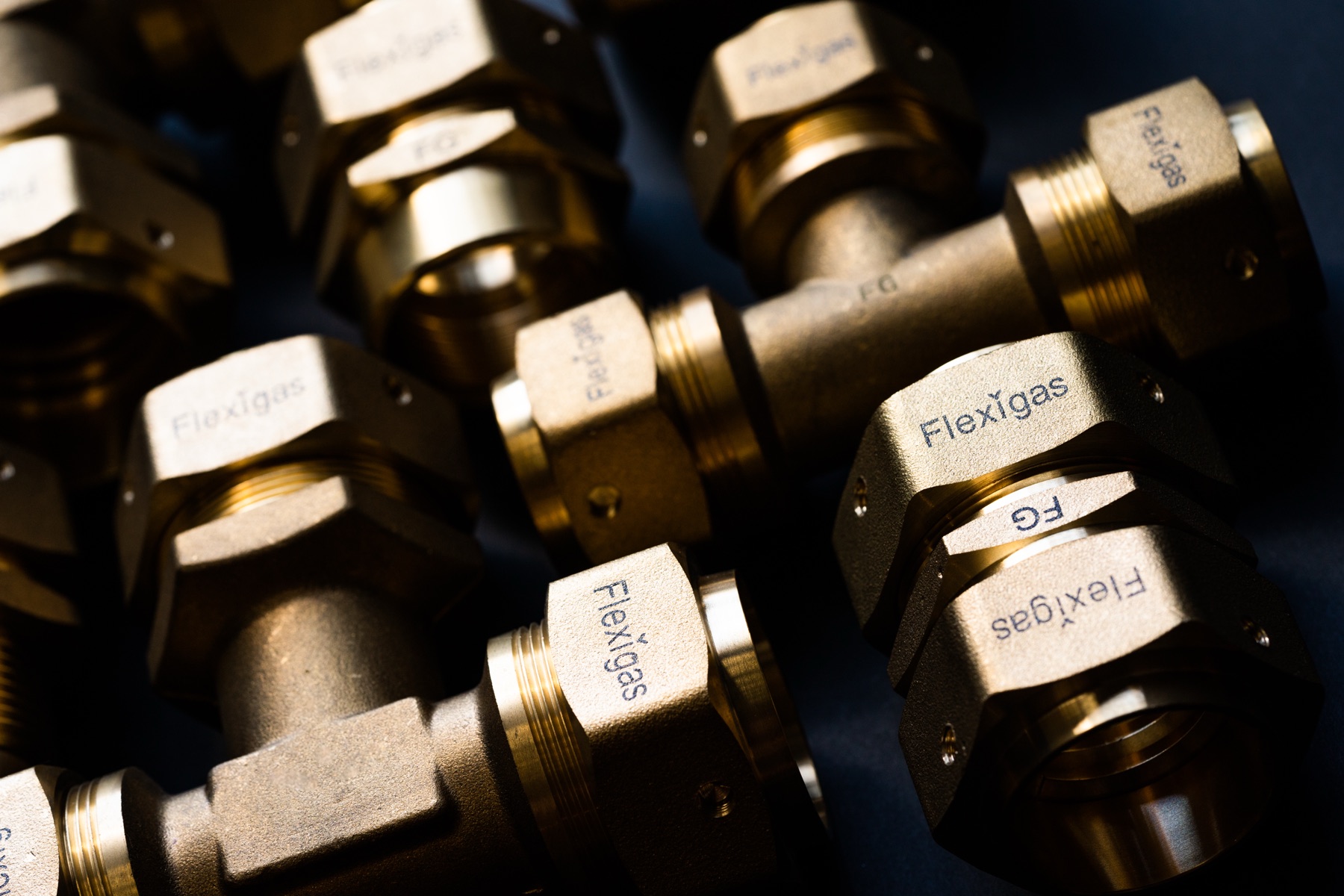
The whole Flexigas range is built to join other materials through standard BSP threads. The fitting makes the dry, all-metal seal onto the Flexigas tube at one end, and presents a male or female BSP thread at the other for the copper, iron or brass side.
Connecting to copper
There is a wide range of copper transition fittings: unions, tees, straight couplers, elbows and reducers (the CC, ECC, EE and EM ranges). Because the internal diameters match copper tube, these behave as straightforward couplings, which is what makes the switch between copper and Flexigas mid-run so clean.
Connecting to iron and brass
Iron and brass are reached the same way: through the BSP thread connection on the Flexigas fitting. The transition is a threaded joint, made up in the normal way for a gas thread, with the Flexigas mechanical seal kept entirely separate at the other end of the fitting.
What is not allowed
- Direct joining to other CSST systems, in any form, regardless of how similar the tube looks.
- Plastic gas pipe in the UK, which is never permitted, whatever the CSST involved.
- Bringing a Flexigas component near fresh solder work before the flux is cleaned off, covered in Section 4 below.
4. The dry, all-metal seal: no flux, no jointing compound on the stainless
This is the most common way an experienced copper installer trips up on a transition joint. The Flexigas seal is mechanical: the corrugated stainless steel tube self-flares against the brass seat as the two halves of the fitting compress it. It is a dry, metal-to-metal seal, and the Manual is explicit: no jointing compound, no PTFE.
So on a joint that has both a Flexigas seal and a BSP thread, keep the two sealing methods on their own sides of the fitting:
- The Flexigas seal goes together dry. No paste, no PTFE, no sealant of any kind on the corrugated tube or the brass seat. Adding tape or paste here breaks the mechanism, it does not improve it.
- The BSP thread is sealed the normal way for a gas thread, with a jointing compound or thread sealant approved for gas. That is the only part of the assembly that gets sealant.
Solder first, clean the flux, then bring Flexigas in
Where soldered copper is going to be joined to Flexigas through a thread fitting, do all the solder work well before any Flexigas component comes near the joint. Before you attach the Flexigas fitting, make sure the corresponding thread is clean, dry and free from any solder flux residue. Flux is chloride-rich and corrosive to both the brass fitting and the stainless tube over time. The sequence is simple: solder, clean off the flux, then make the Flexigas connection.
5. Earth continuity across a material change
Every change of pipe material is a place to think about electrical continuity. All domestic gas installations, including CSST systems such as Flexigas, must have main equipotential bonding of the installation pipework to BS 7671.
Where the bonding clamp can and cannot go
If you use a separate BS 951:2009 bonding clamp, the main protective bonding conductor must not be attached to the Flexigas tubing (the stainless steel) directly. The clamp may only go on the hex part of the Flexigas fittings, or on the copper or rigid steel parts of the installation. The integrated FG Bond terminal threads onto the fitting nut and is tested to BS 951:2009, so it gives you a compliant bonding point at the fitting without a separate clamp. The main bond connects near the point of entry, before any branch, on a sound connection that is not subject to corrosion. For the full bonding requirements, see the FG Bond earth bonding guide and Section 20 of the Installation Manual.
Temporary continuity bond while you work
During any work that connects or disconnects metal installation pipework, fit a temporary continuity bond across the joint, wherever a spark or shock could cause a hazard. Clip it to good metallic contact each side of the union before you break the joint, and leave it until metallic continuity is re-established (at least 1.2m of single-core insulated flexible cable, minimum 10mm², with a robust clip at each end).
6. FG Link and A-XX adapter fittings: hard Kitemark conditions
The FG Link and A-XX adapter fittings (A-15 through A-40) let Flexigas transition to Flowflex brass systems. They are extremely useful, and they carry conditions that are part of the Kitemark scope, not optional good practice. Get either of them wrong and you are outside the certified system.
- Training. Adapter fittings may only be used by stockists and installers who have completed a Flexigas training course on adapter assembly. This is a hard condition of the Kitemark, not a recommendation.
- Compatibility list. Adapter fittings may only be combined with fittings on the Flowflex Compatible Model List, Rev 1, 19 July 2021. Combining them with anything off that list voids the certificate. The list is available from Flexigas.
If you have not done the training, or the fitting you want to combine with is not on the compatibility list, transition through a standard approved BSP threaded connector instead.
7. Quick checklist for a mixed-material joint
- Transition through an approved BSP threaded connector. Never joint dissimilar tube directly. Flexigas tube into Flexigas fittings only, never another brand's CSST.
- Keep the Flexigas seal dry. No flux, no jointing compound, no PTFE on the stainless. Sealant on the BSP thread only.
- Solder first, clean off the flux, then bring Flexigas in.
- Maintain earth continuity. Bond to the hex of the fitting, or to the copper or rigid steel, never to the stainless tube. Use a temporary continuity bond while you work.
- Adapters need training plus the compatibility list. FG Link and A-XX fittings only within the Kitemark conditions.
- Size for gas, not copper-equivalent bore, and gas tightness test before any silicone tape goes on the exposed stainless.