
Sizing Flexigas follows BS 6891 the same way copper does, in four steps. One, work out the required flow Q by adding up the connected appliance gas rates in m3/h (full connected load, no domestic diversity factor). Two, work out the effective length: the measured run plus the equivalent length each fitting adds (a formed 90 degree bend +0.3m, a tee on the through-flow +0.3m, a tee on the diverted branch +0.9m, a coupling +0.3m). Three, look up the BS 6891 natural-gas discharge table at a 1mbar pressure drop, by effective length and DN, and pick the smallest DN that carries at least Q. Four, split the 1mbar total drop across the legs of a multi-leg run. The one thing to never do: do not swap copper for Flexigas like-for-like at the same diameter. Pressure loss in Flexigas is slightly different. Calculate it, or let the in-browser sizing calculator at /gas-pipe-sizing-calculator/ do all four steps live.
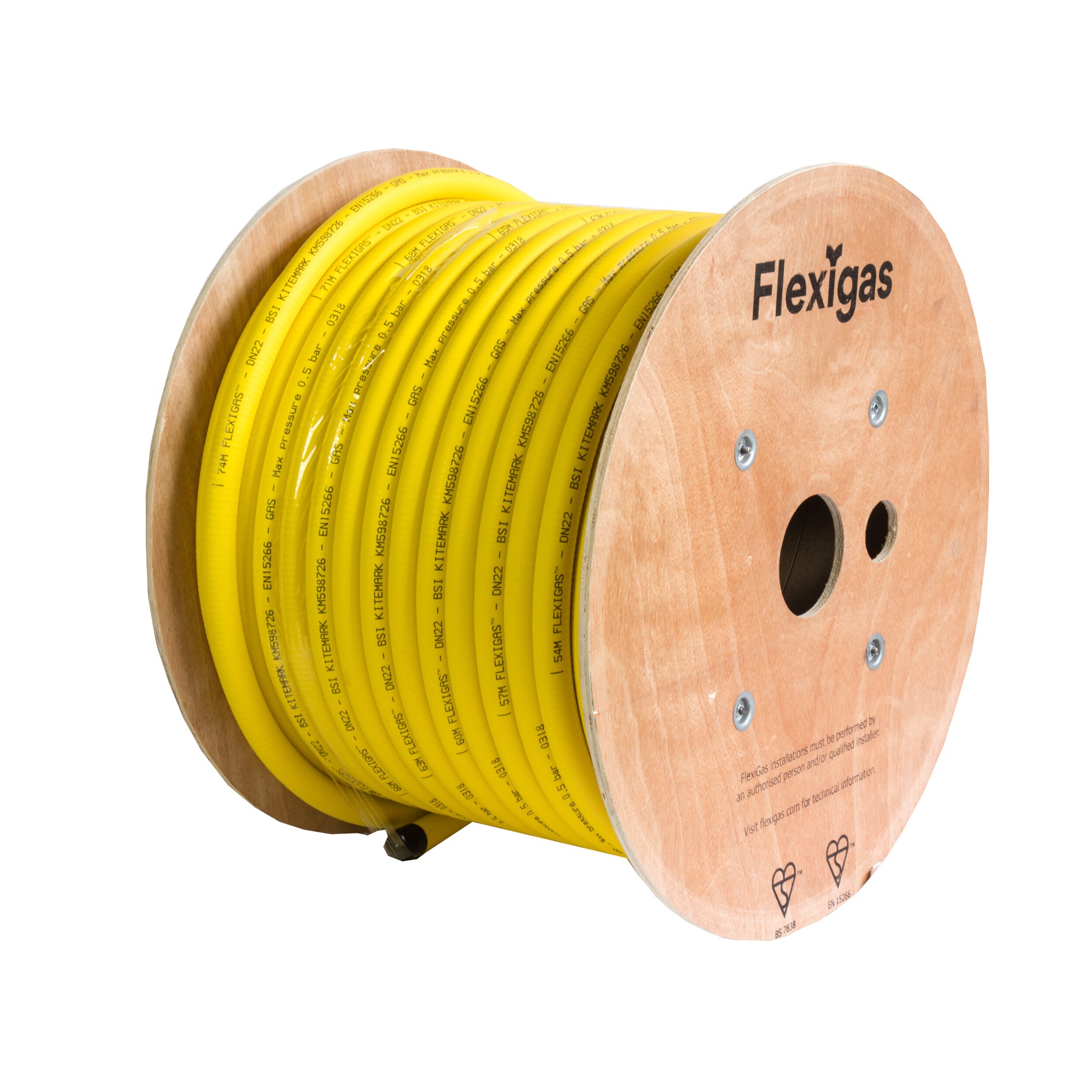
A step-by-step method for sizing a Flexigas Corrugated Stainless Steel Tubing run on a domestic natural-gas install. No marketing copy. Just the BS 6891 method, the numbers, and a worked example. For the full install procedure, see Installing Flexigas CSST: the complete guide.
1. The method in four steps
Sizing gas pipework is the same discipline whatever the material: get enough gas to every appliance under full load without dropping more pressure than the standard allows. For domestic natural gas, BS 6891 sets the budget at 1mbar between the meter outlet and the appliance, with meter pressure at 21mbar. The job is to find the smallest tube that stays inside that budget.
Four steps:
- Work out the required flow Q (the connected gas rate, in m3/h).
- Work out the effective length (measured run plus equivalent length of each fitting).
- Look up the discharge table and pick the smallest DN that carries at least Q.
- Allocate the 1mbar drop across the legs of a multi-leg run.
The same four steps your copper installs already follow. The numbers are Flexigas numbers, so do not assume copper figures carry across at the same diameter (see Section 5). Everything below is from the Flexigas Installation Manual and BS 6891:2015.
2. Step 1, work out the required flow Q
Add up the gas rate of every appliance the run feeds. That sum is Q, the required flow in cubic metres per hour. Use the full connected load: assume every appliance can run at once. There is no domestic diversity factor applied to a dwelling. If the run carries it, size for it.
Take the gross gas rate off each appliance data plate. Where you do not have the plate to hand, the Installation Manual gives these typical rates:
| Appliance | Typical gas rate (m3/h) |
|---|---|
| Combination boiler | 2.5 |
| Multi-point water heater | 2.5 |
| Central heating boiler | 1.5 |
| Cooker | 1.0 |
| Warm air unit | 1.0 |
| Gas fire | 0.5 |
So a dwelling with a combi boiler (2.5), a cooker (1.0) and a gas fire (0.5) has a total connected load of 4.0 m3/h at the meter. A single leg feeding only the cooker and the fire carries 1.5 m3/h. Each leg gets sized for the load it actually carries, not the whole-house total.
3. Step 2, work out the effective length
Pressure is lost along the straight tube and again at every change of direction and every fitting. To account for both in one number, BS 6891 uses an effective length: the measured run length plus an equivalent length added for each fitting.
Measure the real run first. Then add the equivalent length of every fitting on that run:
| Fitting | DN15 to DN28 | DN32 to DN50 |
|---|---|---|
| 90 degree bend (formed in the tube) | +0.3m | +0.3m |
| Tee, through-flow | +0.3m | +0.3m |
| Tee, diverted branch | +0.9m | +1.0m (1.5m at DN50) |
| Coupling or union | +0.3m | +0.3m |
| Elbow fitting | +0.9m | +1.0m |
This is where Flexigas earns its keep. A sweeping bend made by the tube itself counts as a 90 degree bend at +0.3m. A manufactured elbow fitting counts as +0.9m. Because you bend the tube instead of fitting an elbow at every change of direction, you carry far less equivalent length on a real run, which often keeps you on a smaller, cheaper diameter than the same route in copper.
Worked the other way: a 6m run with one through-flow tee has an effective length of 6 + 0.3 = 6.3m. The same run with three elbow fittings instead of formed bends would be 6 + 0.9 + 0.9 + 0.9 = 8.7m, and you look that length up in the table, not the 6m.
4. Step 3, look up the discharge table
With Q and the effective length in hand, go to the BS 6891 natural-gas discharge table. It lists the maximum discharge in m3/h for a 1mbar drop, by tube length and DN. Find the row at (or just above) your effective length, read across, and pick the smallest DN whose discharge is at least Q.
Table 1: Natural gas, approximate discharge (m3/h), 1mbar pressure drop
| Tubing length (m) | DN15 | DN22 | DN28 | DN32 | DN40 | DN50 |
|---|---|---|---|---|---|---|
| 1 | 4.2 | 10.3 | 19.5 | 35.0 | 59.0 | 120.0 |
| 2 | 2.8 | 7.4 | 13.4 | 24.5 | 41.0 | 84.3 |
| 3 | 2.2 | 6.4 | 11.0 | 20.3 | 34.0 | 68.8 |
| 5 | 1.6 | 4.7 | 8.5 | 15.8 | 26.7 | 53.0 |
| 7 | 1.3 | 4.2 | 7.1 | 13.2 | 22.0 | 44.4 |
| 10 | 1.0 | 3.5 | 6.0 | 11.2 | 17.9 | 37.0 |
| 15 | 0.8 | 2.9 | 4.9 | 9.2 | 14.6 | 30.1 |
| 20 | 0.7 | 2.5 | 4.3 | 7.9 | 12.6 | 25.8 |
| 30 | 0.5 | 2.1 | 3.5 | 6.5 | 10.3 | 20.8 |
| 50 | 0.4 | 1.6 | 2.7 | 5.0 | 8.0 | 16.0 |
| 100 | 0.3 | 1.1 | 1.9 | 3.6 | 5.6 | 11.0 |
Read the table conservatively. Where your effective length sits between two rows, use the longer row (the lower discharge figure) so you size with margin rather than against it. Propane and butane have their own discharge tables (Tables 2 and 3), and the pressure-drop tables are Tables 4 to 6, all in Section 29 of the Installation Manual. The in-browser calculator interpolates between rows for you.
5. Step 4, allocate the drop across a multi-leg run
The 1mbar budget is for the whole path from meter outlet to appliance, not for each leg in isolation. On a run that branches, the total drop along any single meter-to-appliance path has to stay within 1mbar, so you split the budget across the legs in series.
In practice: take the longest, most heavily loaded path from the meter to its furthest appliance, decide how much of the 1mbar each leg on that path is allowed, and size each leg against its own share of the drop and its own carried load. A common approach is to give each leg a slice of the 1mbar (for example 0.25mbar to a short branch and the balance to the main run), then size each leg to its slice. Sizing a leg to a fraction of 1mbar is the same as sizing it to 1mbar over a proportionally longer length: a 0.25mbar budget over a 1.8m leg has the same loss profile as 1mbar over 7.2m (four times the length), so you look up 7.2m in the table for that leg. That is exactly the move in the worked example below.
6. Worked example
From the Installation Manual. A length feeds a cooker (1.0) and a gas fire (0.5), so the required flow is Q = 1.5 m3/h. The measured run is 1.5m and it has one through-flow tee where it branches off the main.
- Step 1, flow: cooker 1.0 + gas fire 0.5 = Q = 1.5 m3/h (full connected load, no diversity).
- Step 2, effective length: measured run 1.5m + one through-flow tee (+0.3m) = 1.8m.
- Step 4, the leg's share of the drop: this leg is allowed 0.25mbar of the 1mbar total. A 0.25mbar loss over 1.8m has the same loss profile as 1mbar over 7.2m (4 x 1.8m), so look up 7.2m in Table 1.
- Step 3, table lookup: at 7m, DN15 carries 1.3 m3/h and DN22 carries 4.2 m3/h. DN15 (1.3) does not cover Q = 1.5. DN22 is the size, with comfortable margin for a future appliance on the branch.
The full worked example is in Section 28 of the Installation Manual. Notice the order: flow first, then effective length, then the leg's slice of the budget, then the table. Skip the budget-allocation step on a branched run and you will undersize.
7. The one mistake to never make
Do not swap copper for Flexigas like-for-like at the same diameter. Pressure loss in Flexigas is slightly different to smooth-bore copper, so a route that worked in 22mm copper is not automatically fine in DN22 Flexigas, and vice versa. The corrugated bore and the equivalent lengths are not the same numbers. The Installation Manual is explicit: calculate it, do not assume it.
The upside runs the other way too. Because you bend the tube instead of fitting elbows, a real Flexigas run usually carries less equivalent length than the copper version of the same route, which can drop you onto a smaller, cheaper diameter once you actually do the sum. Either way, the rule is the same: size it from the Flexigas figures, every time.
8. Let the calculator do all four steps
The four-step method is straightforward for a straight horizontal run with one or two fittings. For anything with multiple legs, several fittings, or a tight pressure budget, use the Flexigas in-browser sizing calculator. It runs entirely in your browser (no app to install, nothing to download), takes your appliances and your run, adds the equivalent lengths, interpolates the discharge table, allocates the drop across the legs, and returns the smallest compliant DN for each leg. It uses the same Flexigas Installation Manual data as the tables above.
Three ways to size, in order of speed: the in-browser calculator for anything non-trivial, Tables 1 to 6 in Section 29 of the Installation Manual for a quick hand check, and the manual calculation in Section 28 when you want to see every figure.