This is an honest comparison, not a hit piece on copper. Both are valid gas pipework. Flexigas can help with three things that matter on many jobs: routing time, joint count and labour planning. You pull a continuous flexible run through the joists, with less soldering and hot work than copper routes. Long runs can mean fewer fittings, fewer concealed joints and fewer leak points. Copper still earns its place on short simple runs and exposed runs where a rigid look is wanted, and because the internal diameters match you can switch between the two mid-run. One catch: pressure loss in Flexigas differs slightly from copper, so you cannot swap like-for-like at the same diameter. Size it with the in-browser calculator.
If you already fit copper for gas, the honest question is not which is better in the abstract. It is which method fits the route, the access, the standards context and the labour plan for that job. Both Flexigas CSST and copper are valid gas pipework fitted by a Gas Safe registered engineer. They suit different places.
The short version
| What you care about | Flexigas CSST | Copper |
|---|---|---|
| Install workflow | Flexible continuous runs can reduce routing time on suitable jobs | Rigid route built up fitting by fitting |
| Joints per run | Often fewer, using long continuous runs | A fitting at each change of direction |
| Concealed joints behind walls | Can reduce concealed joint count | More joints where the route changes direction |
| Hot work | Mechanical seal with less hot work than soldered copper routes | Soldering, blowtorch and hot works controls |
| Routing around obstacles | Flexes around many obstacles, subject to bend radius and sizing | Uses soldered fittings around obstacles |
| Installed-cost drivers | Can reduce fittings and labour on suitable longer or more complex routes | Can be practical on short, simple or exposed routes |
| Short, simple, exposed runs | Works, but copper may be suitable too | Often the easier pick where a rigid exposed look is wanted |
1. Workflow: pull it through like cable
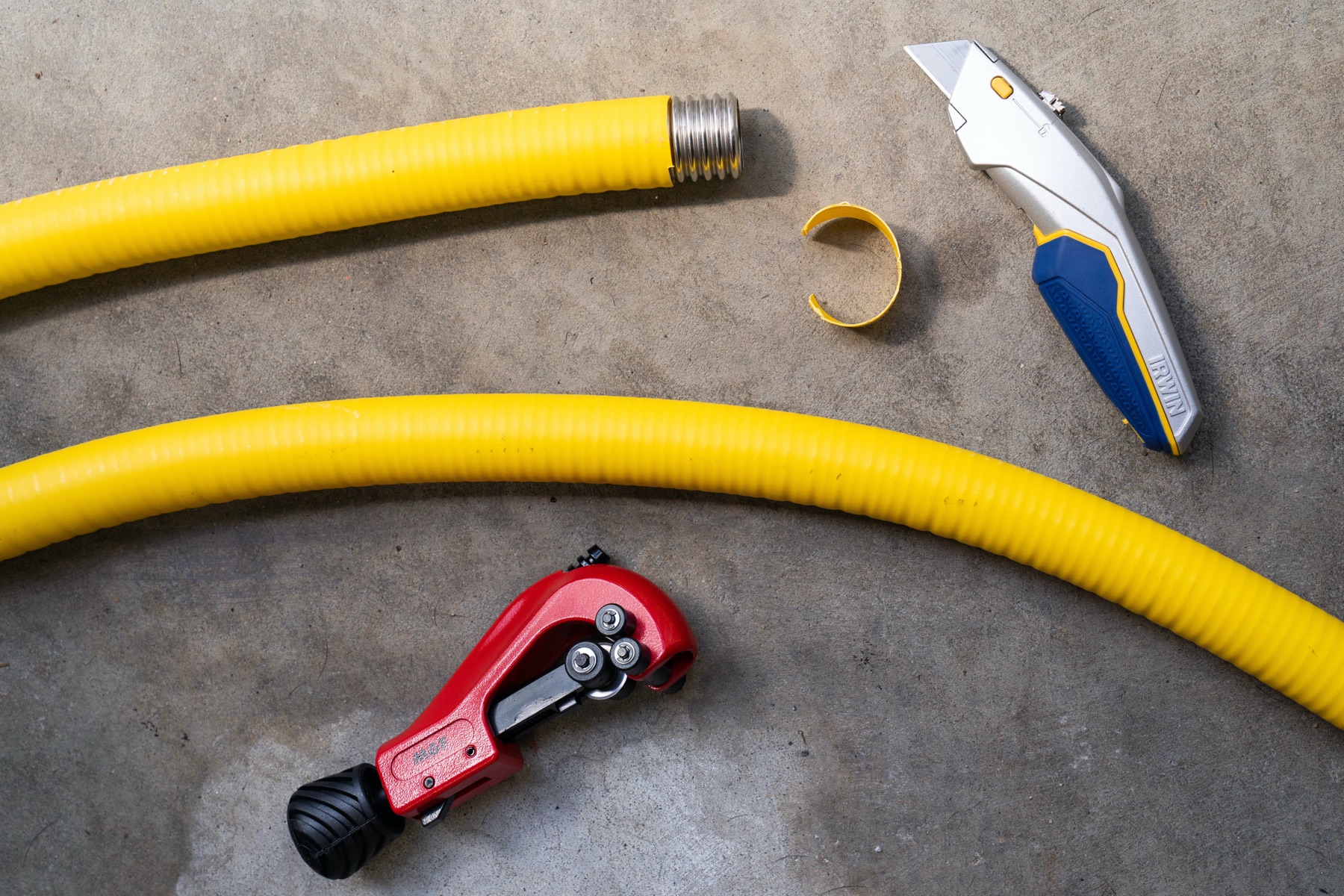
The headline workflow difference is the way the route is built. Copper is assembled fitting by fitting: cut, ream, clean, flux, assemble, solder and repeat at every bend. Flexigas is a continuous flexible tube that can be pulled through a route and then terminated where a connection is needed, subject to sizing, bend radius, support and installation guidance.
It comes in long coils, so on suitable domestic runs you can often pull a single length from meter to appliance with no joints in between, assuming the route allows. There is no soldering along that run, so the install workflow can be simpler on routes where copper would need several direction changes.
2. Joints: fewer fittings, fewer concealed leak points
Every joint is a potential leak point, and the ones you cannot inspect again matter most. Copper needs a fitting at every change of direction, and on a real route many end up concealed behind walls, under floors and above ceilings. Because Flexigas runs as long continuous lengths, you make far fewer joints, so fewer concealed joints and fewer leak points buried in the structure. This is not a claim that copper joints fail: properly made they are sound. It is the simpler point that the fewer joints a system needs, the fewer things there are to make, test and worry about later.
3. Hot works: fewer open-flame steps
The Flexigas seal is mechanical. The corrugated stainless steel tube self-flares against a brass seat as you tighten the fitting with two spanners. No solder, no flux, no jointing compound and no PTFE on the seal. On routes where soldered copper would otherwise be used, that can reduce open-flame work near timber, membranes or insulation and can simplify hot-work planning on occupied buildings and commercial sites. Copper soldering is a known, controlled process engineers use every day, but it should still be managed as hot work where required.
4. Cost drivers: fittings and labour
Reducing elbows and couplings can change the cost picture on suitable routes. Every copper elbow and coupling is a part you buy plus the solder and flux to fit it, while a continuous Flexigas run can use fewer fittings. The bigger lever is often labour: less cutting, soldering and jointing can reduce site time on longer or more complex routes, subject to the actual route and sizing.
Flexigas can be commercially attractive in the larger DN28 to DN50 sizes, where fitting count, access and labour planning often matter more. On short DN15 and DN22 runs with one or two joints the gap can be narrower, which is part of why copper still makes sense in some places.
5. Routing: flex around what copper solders around
Real routes are full of obstacles: steels, ducts, other services, awkward corners. Copper deals with them by adding fittings to change direction around each one. Flexigas deals with many changes of direction by bending, subject to the bend radius and support rules. A sizing point worth knowing: a sweeping bend made by the tube is treated differently from a separate elbow fitting in the Flexigas sizing calculator, so use the calculator rather than assuming a copper-style route.
6. Where copper still makes sense
An honest comparison says this plainly: copper is not beaten everywhere.
- Short, simple runs. A straight run with one or two joints is quick in copper, where the Flexigas advantages are smallest.
- Exposed runs where a rigid look is wanted. In a plant room or boiler house, or anywhere the pipework is on show and the customer or specifier wants the clean rigid line of copper, copper is the better aesthetic. Flexigas is built to be pulled through and concealed.
You do not have to choose one for the whole job. The internal diameters match copper, so you can switch between the two mid-run through approved BSP thread connectors: pull Flexigas through the difficult concealed section, then transition to copper for the exposed final tail, or complete the whole install in Flexigas. Around 99% of the way you install copper applies to Flexigas, so this is not a system you learn from scratch.
7. The one thing you cannot do: swap diameters like-for-like
This is the catch that trips people up. Pressure loss in Flexigas is slightly different to copper. The corrugated bore does not flow identically to smooth copper tube at the same nominal size, so you cannot swap a copper diameter for the same Flexigas diameter and assume the install works.
Size the run properly. On some runs the calculation will tell you to go up a size versus the copper you would have used. That is normal. The right answer depends on route length, appliance load, fittings, bends and pressure loss. Use the Flexigas in-browser sizing calculator at flexigas.com/gas-pipe-sizing-calculator/: it runs in your browser, free, no app to download, and accounts for the equivalent lengths of bends and fittings so you size right first time. For anything more than a short straight run with one or two fittings, use it.
The verdict
Both are valid gas pipework, fitted by a Gas Safe registered engineer to the same standards. Copper holds its ground on short simple runs and exposed runs where a rigid look is wanted. Flexigas is often a strong fit where routing flexibility, fewer intermediate joints and less hot work matter. Reach for the right one per job and size it with the calculator.